



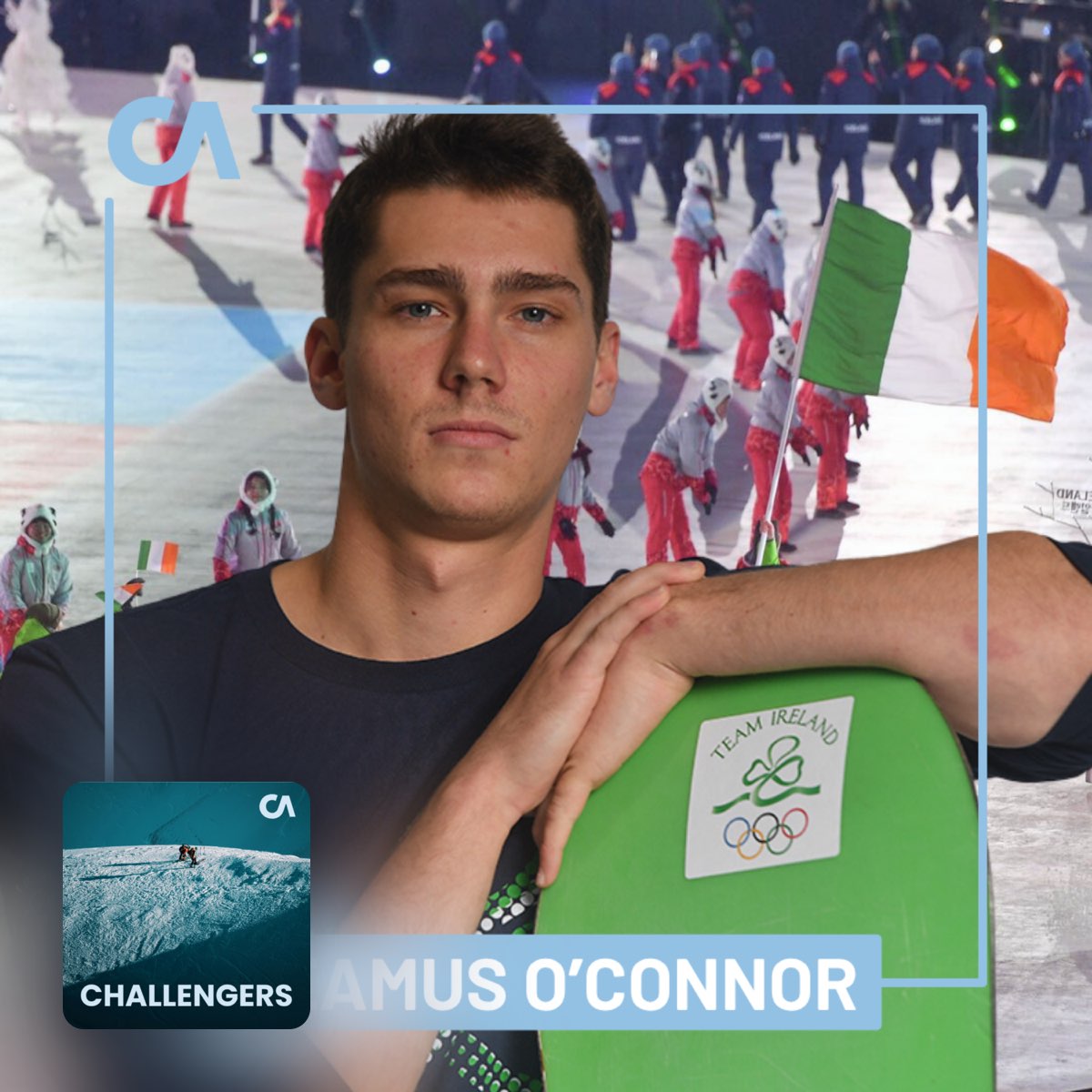
Some conversations pull you back to the beginning — to the moment before the goals, before the pressure, before the points. My exchange with Seamus O'Connor was one of them.
A three-time Winter Olympian representing Ireland in snowboard halfpipe and slopestyle, Seamus was born in the United States to an Irish father and a Russian mother. He began competing at the World Cup level at 13, became Ireland's first freestyle snowboarder, and carried the Irish flag at the 2018 Pyeongchang opening ceremony. He is currently completing a master's degree while preparing a potential qualification campaign for the 2026 Winter Olympics in the French Alps.
Behind those credentials is someone who thinks deeply about what sport actually does to a person — and what it gives back.
Representing a Country: More Than Where You Were Born
The first thread in our conversation is the one that shapes everything else: what does it mean to represent a country?
Seamus is American-born. His mother is Russian, his father Irish. He grew up with a Russian grandfather at home, summers in Ireland, ties on every side. When his father first floated the idea of competing for Ireland — with the 2014 Sochi Games in mind, a city where Seamus had family — he was barely eight or nine years old. By 13, he was on the World Cup circuit under the Irish flag.
The decision wasn't administrative. It was about carrying forward the parts of yourself that don't always get space.
"Unless you have the opportunity to represent and display them, they can become a little bit of an unsung part of who you are."
For athletes navigating dual nationalities, the question is worth sitting with. Representing a larger team might mean better resources. It might also mean four slots for twenty athletes, and a seat on the bench. Representing a smaller country can mean something more: a platform that is entirely yours, and a community that needs exactly what you can offer.
The Flag Bearer: When a Career Peaks in a Single Moment
Seamus describes the 2018 Pyeongchang opening ceremony — where he carried the Irish flag — as the peak of his sporting career. Not a podium finish. Not a qualification. A walk into a stadium with a flag in his hands and his team behind him.
What made it the peak wasn't the visibility. It was the completeness of the moment: his father walking out in the parade with the team, every thread of his identity present at once — Irish, American, athlete, son.
"I turned around and started walking towards my team in the wrong direction. I was jumping for joy, I couldn't even fathom it."
He hadn't thought about it in a long time before we spoke. A professor had asked the class to recall a transformative experience, and it came back immediately — larger than life, fully present. That's the thing about moments like that: they don't require maintenance. They're always there when needed.
Visualisation: The Mental Rep That Compounds
Seamus credits a significant part of his development to visualisation — a practice he was initially sceptical of and later came to rely on completely.
As a young athlete, someone told him: if you can see it clearly in your mind, you can do it. He thought it was nonsense. He had a small snowboard figurine that he used to map out tricks with his hands, working through the mechanics physically before committing them to mental imagery. Trampoline work and foam pit sessions helped build body awareness — the sense of where you are in the air, which is the foundation everything else rests on.
The transfer to daily life is direct. Before a presentation, he walks himself through the experience the same way he used to walk himself through a halfpipe run: what will it feel like to stand in front of the room, what will he do with his hands, what will it feel like when he sits back down. The process is identical. The stakes are different; the mechanism is the same.
"I still get that anxious feeling. So I find myself walking through it — what is it going to look like, how is it going to feel when I do it successfully."
For athletes transitioning into professional environments, this is worth holding onto. The mental toolkit isn't sport-specific. It travels.
The Injury: Losing the Thread and Finding It Again
Later in his career, Seamus had a serious knee injury that kept him off snow for nearly a year and off his feet for over two months. In the period before, things had become robotic — training sessions, qualification points, sponsorship obligations, going through the motions.
The injury forced stillness. And in that stillness, something came back.
He asked to do his rehabilitation in Utah rather than California — not because of better facilities, but because he needed to be near the mountains. That proximity was enough. It reminded him what had pulled him in to begin with: not results, not recognition, but the feeling of being alive on the board.
"I was almost thankful for that injury. Without it, I was losing some of that magic — the thing that makes it desirable and fun."
The lesson isn't that injury is useful. It's that it forced a question that busyness had been preventing: why are you doing this? For athletes and professionals alike, that question doesn't always get asked until something stops you from continuing.
Legacy Over Achievement: A Different Kind of Goal
Seamus describes a clear evolution in his goals across three Olympic cycles. As a child: be the best snowboarder in the world. As a developing athlete: qualify, perform, earn results. Now: leave something behind.
He is currently Ireland's first and only freestyle snowboarder. He doesn't intend to be the last.
"Irish snow sports has really blown up. The interest has skyrocketed. We just have to keep hammering at it — keep letting people know there are other options."
Beyond Irish snow sports specifically, his focus is athlete welfare: the gap between organisations that claim to be athlete-centred and what that actually looks like in practice. His parents worked in mental health. He studied psychology. The master's degree is the next layer.
The shift from achievement to legacy isn't a retreat from ambition. It's a reorientation of it — from what can be accumulated to what can be passed on.
His Advice to a Young Irish Snowboarder
The closing question: what would he say to a 13-year-old who saw him carrying that flag and wants to do the same?
Go for it. Don't give up that goal. But understand that the road is long, and the destination isn't really the point.
"I was on the top of a mountain in Europe sliding down snow on a board. My friends were in school. I shouldn't be here. This is so special."
That recognition came late for him. He was so focused on qualifying, accruing points, securing sponsorships, that the actual experience was partially lost. His advice is to start noticing earlier — not to relax the discipline, but to stay present within it.
What he takes away from his career isn't the results. It's the people, the places, the cultures, the friendships built at the top of a halfpipe in a country far from home.
Find Seamus O'Connor on Linkedin and follow his journey toward the 2026 Winter Olympics.
Challengers Agency supports athletes and sports professionals in building their career, brand, and partnerships. Subscribe to the podcast — new episode every month.


